# OneLogin Group

Administrators can create groups to manage settings and access to services for different sets of users. Users can utilize groups to manage and secure access to applications and data across different devices and environments.

Through this integration, Apono helps you securely manage access for sets of users in your OneLogin instance.

***

### Prerequisites

<table><thead><tr><th width="250">Item</th><th>Description</th></tr></thead><tbody><tr><td><strong>Apono Connector</strong></td><td><p>On-prem connection serving as a bridge between an OneLogin instance and Apono:</p><ul><li><a href="../../aws-environment/apono-connector-for-aws">AWS</a></li><li><a href="../../azure-environment/apono-connector-for-azure">Azure</a></li><li><a href="../../gcp-environment/apono-connector-for-gcp">GCP</a></li><li><a href="../../kubernetes-environment/apono-connector-for-kubernetes">Kubernetes</a></li></ul></td></tr><tr><td><strong>OneLogin Super User Account</strong></td><td>OneLogin account that possesses user management permissions</td></tr><tr><td><strong>OneLogin Organization Subdomain</strong></td><td><p>Unique subdomain of your OneLogin instance<br><br>Follow these steps to obtain the subdomain:</p><ol><li>Log in to OneLogin.</li><li>Copy the subdomain from the URL in the address bar. Be sure to remove the protocol (<code>https://</code>), <code>onelogin.com</code> domain, and any suffix.</li></ol></td></tr></tbody></table>

***

### Create OneLogin credentials

You must create credentials in your OneLogin instance for the Apono connector.

Follow these instructions to create the credentials:

1. Log in to OneLogin Admin UI using an admin account with Super User privileges.
2. Click **Administration**.
3. In the menu, click **Developers > API Credentials**. The **Create new API credential** page appears.
4. Click **New Credential**.
5. Create a new credential with the **Manage users** scope.
6. Using the credentials from the previous step, [create a secret](https://docs.apono.io/docs/connectors-and-secrets/apono-integration-secret) for the OneLogin instance.

You can now [integrate your OneLogin instance](#integrate-onelogin-group).

***

### Integrate OneLogin Group

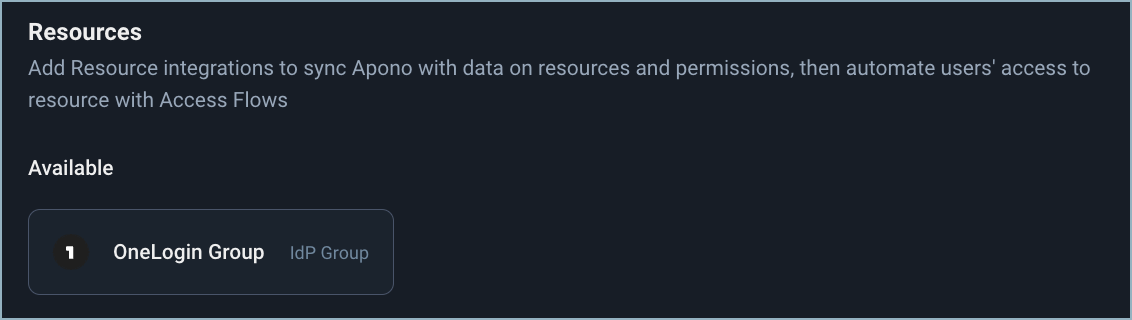
<figure><img src="https://1094436629-files.gitbook.io/~/files/v0/b/gitbook-x-prod.appspot.com/o/spaces%2Fv6MBfUGvblSdAz31yJXm%2Fuploads%2Fgit-blob-31e7c6a1ca9f33dc96b28b3daa8b0ea5abe334f4%2FOnelogin-group-1.png?alt=media" alt="" width="563"><figcaption><p>OneLogin Group tile</p></figcaption></figure>

{% hint style="success" %}
You can also use the steps below to integrate with Apono using Terraform.

In step **10**, instead of clicking **Confirm**, follow the **Are you integrating with Apono using Terraform?** guidance.
{% endhint %}

Follow these steps to complete the integration:

1. On the [**Catalog**](https://app.apono.io/catalog?search=onelogin+group) tab, click **OneLogin Group**. The **Connect Integration** page appears.
2. Under **Discovery**, click **Next**. The **Apono connector** section expands.
3. From the dropdown menu, select a connector.

{% hint style="info" %}
If the desired connector is not listed, click **+ Add new connector** and follow the instructions for creating a connector ([AWS](https://docs.apono.io/docs/aws-environment/apono-connector-for-aws), [Azure](https://docs.apono.io/docs/azure-environment/apono-connector-for-azure), [GCP](https://docs.apono.io/docs/gcp-environment/apono-connector-for-gcp), [Kubernetes](https://docs.apono.io/docs/kubernetes-environment/apono-connector-for-kubernetes)).
{% endhint %}

4. Click **Next**. The **Integration Config** section expands.
5. Define the **Integration Config** settings.

   <table><thead><tr><th width="214">Setting</th><th>Description</th></tr></thead><tbody><tr><td><strong>Integration Name</strong></td><td>Unique, alphanumeric, user-friendly name used to identify this integration when constructing an access flow</td></tr><tr><td><strong>Subdomain</strong></td><td>OneLogin subdomain</td></tr></tbody></table>
6. Click **Next**. The **Secret Store** section expands.
7. [Associate the secret or credentials](https://docs.apono.io/docs/connectors-and-secrets/apono-integration-secret).
8. Click **Next**. The **Get more with Apono** section expands.
9. Define the **Get more with Apono** settings.

   <table><thead><tr><th width="217">Setting</th><th>Description</th></tr></thead><tbody><tr><td><strong>Credential Rotation</strong></td><td>(Optional) Number of days after which the database credentials must be rotated<br><br>Learn more about the <a href="../../architecture-and-security/credentials-rotation-policy">Credentials Rotation Policy</a>.</td></tr><tr><td><strong>User cleanup after access is revoked (in days)</strong></td><td><p>(Optional) Defines the number of days after access has been revoked that the user should be deleted</p><p><br>Learn more about <a href="../../architecture-and-security/periodic-user-cleanup-and-deletion">Periodic User Cleanup &#x26; Deletion</a>.</p></td></tr><tr><td><strong>Custom Access Details</strong></td><td>(Optional) Instructions explaining how to access this integration's resources<br><br>Upon accessing an integration, a message with these instructions will be displayed to end users in the User Portal. The message may include up to <strong>400 characters</strong>.<br><br>To view the message as it appears to end users, click <strong>Preview</strong>.</td></tr><tr><td><strong>Integration Owner</strong></td><td><p>(Optional) Fallback approver if no <a href="../../access-flows/dynamic-access-management/resource-and-integration-owners">resource owner</a> is found<br><br>Follow these steps to define one or several integration owners:</p><ol><li>From the <strong>Attribute</strong> dropdown menu, select <strong>User</strong> or <strong>Group</strong> under the relevant identity provider (IdP) platform.</li><li>From the <strong>Value</strong> dropdown menu, select one or multiple users or groups.</li></ol><p><br><strong>NOTE</strong>: When <strong>Resource Owner</strong> is defined, an <strong>Integration Owner</strong> must be defined.</p></td></tr><tr><td><strong>Resource Owner</strong></td><td><p>(Optional) Group or role responsible for managing access approvals or rejections for the resource<br><br>Follow these steps to define one or several <a href="../../access-flows/dynamic-access-management/resource-and-integration-owners">resource owners</a>:</p><ol><li>Enter a <strong>Key name</strong>. This value is the name of the tag created in your cloud environment.</li><li>From the <strong>Attribute</strong> dropdown menu, select an attribute under the IdP platform to which the key name is associated.<br><br>Apono will use the value associated with the key (tag) to identify the resource owner. When you update the membership of the group or role in your IdP platform, this change is also reflected in Apono.</li></ol><p><br><strong>NOTE</strong>: When this setting is defined, an <strong>Integration Owner</strong> must also be defined.</p></td></tr></tbody></table>
10. Click **Confirm**.

<details>

<summary>💡Are you integrating with Apono using Terraform?</summary>

If you want to integrate with Apono using Terraform, follow these steps instead of clicking **Confirm**:

1. At the top of the screen, click **View as Code**. A modal appears with the completed Terraform configuration code.
2. Click to copy the code.
3. Make any additional edits.
4. Deploy the code in your Terraform.

Refer to [Integration Config Metadata](https://docs.apono.io/metadata-for-integration-config/integration-metadata/onelogin-group) for more details about the schema definition.

</details>

Now that you have completed this integration, you can [create access flows](https://docs.apono.io/docs/access-flows/access-flows) that grant permission to your OneLogin instance.