> For the complete documentation index, see [llms.txt](https://docs.apono.io/llms.txt). Markdown versions of documentation pages are available by appending `.md` to page URLs; this page is available as [Markdown](https://docs.apono.io/docs/connectors-and-secrets/apono-integration-secret/apono-secret-alternative.md).
# Apono Secret Alternative
Provide Apono with credentials to authenticate an integration
{% hint style="danger" %}
**We do not recommend using the Apono Secret alternative in any production environment.**
We advise creating a secret in an [AWS](https://docs.apono.io/docs/apono-connector-for-aws) , [Azure](https://docs.apono.io/docs/apono-azure-connector) , [GCP](https://docs.apono.io/docs/apono-connector-for-gcp) , or [Kubernetes](https://docs.apono.io/docs/apono-connector-for-kubernetes) environment. Managing secrets in a Secret Store allows Apono to sync and provision access to cloud resources without needing to store credentials for a specific environment in Apono.
{% endhint %}
During the process of setting up most integrations, you will be prompted to enter secret information associated with the integration, so that the connector can list and provision the integration's resources.
This Apono secret alternative is an authentication solution that allows Apono to sync and provision access to cloud resources with stored credentials. We recommend using this for **development** and **testing purposes**.
***
## Add credentials
Follow these steps to add resource-specific credentials to test an integration:
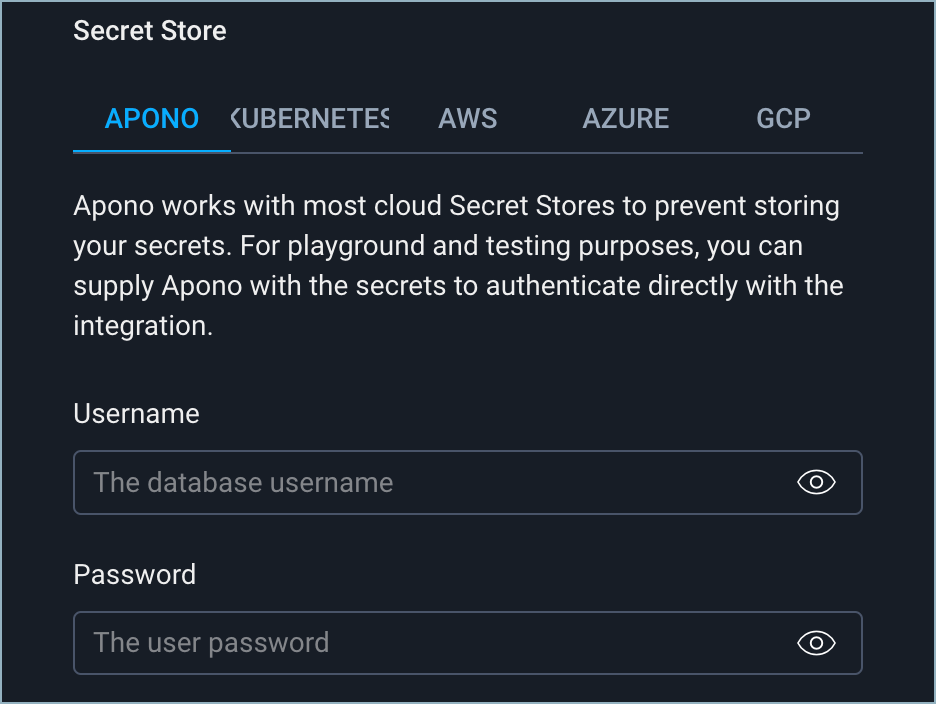
1. Expand **Secret Store**, click on the **APONO** tab.
2. Enter the required credential information for the resource.
Amazon Redshift
* Username
* Password
Azure Kubernetes Service (AKS)
* Enter the Service Account Token
Elastic Kubernetes Service (EKS)
* Enter the Service Account Token
F5 Network
* Enter the admin Username
* Enter the admin Password
Github
* Enter the database Github Token (Personal Access Token)
Google Cloud SQL - MySQL
* Enter the database Username
* Enter the database Password
Google Cloud SQL - PostgreSQL
* Enter the database Username\* Enter the database Password
Google Kubernetes Engine (GKE)
* Enter the Service Account Token
JumpCloud
* Enter the Jumpcloud API Token
Kubernetes
* Enter the database Service Account Token
LDAP Group
* Enter the database Username
* Enter the database Password
Microsoft SQL Server
* Enter the database Username
* Enter the database Password
MongoDB
* Enter the database Username
* Enter the database Password
MongoDB Atlas
* Enter the database Public Key
* Enter the database Private Key
MongoDB Atlas Portal
* Enter the database Public Key
* Enter the database Private Key
MySQL
* Enter the database Username
* Enter the database Password
Okta Group
* Enter the Okta API Token
OR
* Enter the Okta Client ID
* Enter the Private Key
OneLogin
* Enter the Client Id
* Enter the Client Secret
Oracle Database
* Enter the database Username
* Enter the database Password
PostgreSQL
* Enter the database Username
* Enter the database Password
SSH
* Enter the Base64 Private Key OR Password
Vertica
* Enter the database Username
* Enter the database Password
---
# Agent Instructions
This documentation is published with GitBook. GitBook is the documentation platform designed so that both humans and AI agents can read, navigate, and reason over technical content effectively. Learn more at gitbook.com.
## Querying This Documentation
If you need additional information that is not directly available in this page, you can query the documentation dynamically by asking a question.
Perform an HTTP GET request on the current page URL with the `ask` query parameter, and the optional `goal` query parameter:
```
GET https://docs.apono.io/docs/connectors-and-secrets/apono-integration-secret/apono-secret-alternative.md?ask=&goal=
```
`ask` is the immediate question: it should be specific, self-contained, and written in natural language.
`goal` is optional and describes the broader end goal you are ultimately trying to accomplish on behalf of the user. GitBook uses it to tailor the answer towards what is most useful for that goal.
The response will contain a direct answer to the question and relevant excerpts and sources from the documentation.
Use this mechanism when the answer is not explicitly present in the current page, you need clarification or additional context, or you want to retrieve related documentation sections.