# Harmony SASE

**Harmony Secure Access Service Edge** (SASE) provides cloud-delivered network security, allowing organizations to streamline secure remote access with precision.

Integrating Harmony SASE with Apono allows you to automate just-in-time access by temporarily adding users to specific Harmony SASE groups. This ensures the right users get access only when needed and are automatically removed when access expires, which is ideal for short-term projects or incident response. This approach strengthens security, reduces operational overhead, and supports least-privilege access practices.

***

### Prerequisites

<table><thead><tr><th width="211">Item</th><th>Description</th></tr></thead><tbody><tr><td><strong>Harmony account access</strong></td><td>Harmony SASE user account hosted by Perimeter 81 or Check Point</td></tr><tr><td><strong>Apono connector</strong></td><td><p>On-prem connection serving as a bridge between an SSH server and Apono:</p><ul><li><a href="/pages/U4HFH35XWDo3jyqhJqgQ">AWS</a></li><li><a href="/pages/ztAsRPKJcMNxeQKE2GNB">Azure</a></li><li><a href="/pages/xPrzAcLGsoliEpPJuozp">GCP</a></li><li><a href="/pages/p5PzUV4THznqePSTYgEH">Kubernetes</a></li></ul><p>Learn how to update an existing <a href="/pages/cNMceTvopbZdVqebcrk5">AWS</a>, <a href="/pages/qX1nxTxfqQ683NIJVRn5">Azure</a>, <a href="/pages/TmT0CXNeTeCE9vImZPl4">GCP</a>, or <a href="/pages/PGql18C6xhmOlcwdDh6b">Kubernetes</a> connector.</p></td></tr><tr><td><strong>Harmony API key</strong></td><td><p>Unique key generated in Harmony platform to authenticate connection with Apono<br><br>Learn how to <a href="https://support.perimeter81.com/docs/api-getting-started#authentication-and-authorization">generate an API key</a> with Harmony.<br><br><strong>NOTE</strong>: When creating the key, select all <strong>Key Permissions</strong> under the following categories for Apono to access your Harmony instance:</p><ul><li><strong>Members</strong></li><li><strong>Groups</strong></li></ul></td></tr><tr><td><strong>Apono secret</strong></td><td><p>Value generated with the credentials of the user you create</p><p><a href="/pages/JNgTP4bNCaoEbFgb5FSx">Create your secret</a> based on your Redis Cloud API account key and user key:</p><ul><li><code>"api_key": &#x3C;ACCOUNT_KEY></code></li><li><code>"secret_key": &#x3C;USER_KEY></code></li></ul><p><em>Apono does not store credentials. The Apono Connector uses the secret to communicate with services in your environment and separate the Apono web app from the environment for maximal</em> <a href="/pages/YaRPMY9jQ9KkmZHbsklj"><em>security</em></a><em>.</em></p></td></tr></tbody></table>

***

### Integrate Harmony SASE

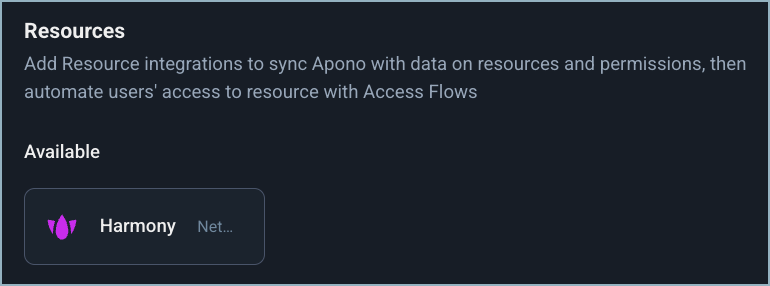
<figure><img src="/files/s3VzV9QQr8PlIPDhzOcn" alt="" width="375"><figcaption><p><em>Harmony tile</em></p></figcaption></figure>

{% hint style="success" %}
You can also use the steps below to integrate with Apono using Terraform.

In step **10**, instead of clicking **Confirm**, follow the **Are you integrating with Apono using Terraform?** guidance.
{% endhint %}

Follow these steps to complete the integration:

1. On the [**Catalog**](https://app.apono.io/catalog?search=harmony) tab, click **Harmony**. The **Connect Integration** page appears.
2. Under **Discovery**, click **Next**. The **Apono connector** section expands.
3. From the dropdown menu, select a connector. Choosing a connector links Apono to all the services available on the account where the connector is located.

{% hint style="info" %}
If the desired connector is not listed, click **+ Add new connector** and follow the instructions for creating a connector ([AWS](/docs/aws-environment/apono-connector-for-aws.md), [Azure](/docs/azure-environment/apono-connector-for-azure.md), [GCP](/docs/gcp-environment/apono-connector-for-gcp.md), [Kubernetes](/docs/kubernetes-environment/apono-connector-for-kubernetes.md)).
{% endhint %}

4. Click **Next**. The **Integration Config** page appears.
5. Enter a unique, alphanumeric, user-friendly **Integration Name** to identify the integration when constructing an access flow.
6. From the dropdown menu, select a **Region** for the config’s activity.
7. Click **Next**. The **Secret Store** section expands.
8. [Associate the secret or credentials](/docs/connectors-and-secrets/apono-integration-secret.md).

{% hint style="info" %}
If you select the Apono secret manager, enter the value of your [**Harmony SASE workspace API Key**](#prerequisites).
{% endhint %}

9. Click **Next**. The **Get more with Apono** section expands.
10. Define the **Get more with Apono** settings.

<table><thead><tr><th width="212">Setting</th><th>Description</th></tr></thead><tbody><tr><td><strong>Custom Access Details</strong></td><td>(Optional) Instructions explaining how to access this integration's resources<br><br>Upon accessing an integration, a message with these instructions will be displayed to end users in the User Portal. The message may include up to <strong>400 characters</strong>.<br><br>To view the message as it appears to end users, click <strong>Preview</strong>.</td></tr><tr><td><strong>Integration Owner</strong></td><td><p>(Optional) Fallback approver if no <a href="/pages/Ey4wuziyr2BzKYQnd5am">resource owner</a> is found<br><br>Follow these steps to define one or several integration owners:</p><ol><li>From the <strong>Attribute</strong> dropdown menu, select <strong>User</strong> or <strong>Group</strong> under the relevant identity provider (IdP) platform.</li><li>From the <strong>Value</strong> dropdown menu, select one or multiple users or groups.</li></ol><p><strong>NOTE</strong>: When <strong>Resource Owner</strong> is defined, an <strong>Integration Owner</strong> must be defined.</p></td></tr><tr><td><strong>Resource Owner</strong></td><td><p>(Optional) Group or role responsible for managing access approvals or rejections for the resource<br><br>Follow these steps to define one or several <a href="/pages/Ey4wuziyr2BzKYQnd5am">resource owners</a>:</p><ol><li>Enter a <strong>Key name</strong>. This value is the name of the tag created in your cloud environment.</li><li>From the <strong>Attribute</strong> dropdown menu, select an attribute under the IdP platform to which the key name is associated.<br><br>Apono will use the value associated with the key (tag) to identify the resource owner. When you update the membership of the group or role in your IdP platform, this change is also reflected in Apono.</li></ol><p><strong>NOTE</strong>: When this setting is defined, an <strong>Integration Owner</strong> must also be defined.</p></td></tr></tbody></table>

10. Click **Confirm**.

<details>

<summary>💡Are you integrating with Apono using Terraform?</summary>

If you want to integrate with Apono using Terraform, follow these steps instead of clicking **Confirm**:

1. At the top of the screen, click **View as Code**. A modal appears with the completed Terraform configuration code.
2. Click to copy the code.
3. Make any additional edits.
4. Deploy the code in your Terraform.

Refer to [Integration Config Metadata](https://docs.apono.io/metadata-for-integration-config/integration-metadata/ssh) for more details about the schema definition.

</details>

#### Usage

Now that the integration is complete, you can add Harmony SASE to define the grantees or resources in an access flow. This allows only the correct requesters to securely access your Harmony-synced groups, based on the access flow’s approval and provisioning rules.

Follow the guidance in these articles to define the resource using Harmony SASE.

<table><thead><tr><th width="217.41015625">Access flow type</th><th>Resources</th></tr></thead><tbody><tr><td><strong>Self Serve</strong></td><td><ul><li><a href="/pages/sVn2oYvXxhOI9ZIEDDvo#define-permitted-requestors">Define permitted requesters</a></li><li><a href="/pages/sVn2oYvXxhOI9ZIEDDvo#define-the-resource">Define the resource</a></li></ul></td></tr><tr><td><strong>Automatic</strong></td><td><ul><li><a href="/pages/6AmJIkxmv8PL0PY3GqOK#define-permitted-users">Define permitted requesters</a></li><li><a href="/pages/6AmJIkxmv8PL0PY3GqOK#define-the-resource">Define the resource</a></li></ul></td></tr></tbody></table>


---

# Agent Instructions: Querying This Documentation

If you need additional information that is not directly available in this page, you can query the documentation dynamically by asking a question.

Perform an HTTP GET request on the current page URL with the `ask` query parameter:

```
GET https://docs.apono.io/docs/additional-integrations/network-management/harmony-sase.md?ask=<question>
```

The question should be specific, self-contained, and written in natural language.
The response will contain a direct answer to the question and relevant excerpts and sources from the documentation.

Use this mechanism when the answer is not explicitly present in the current page, you need clarification or additional context, or you want to retrieve related documentation sections.