# Webhooks Overview

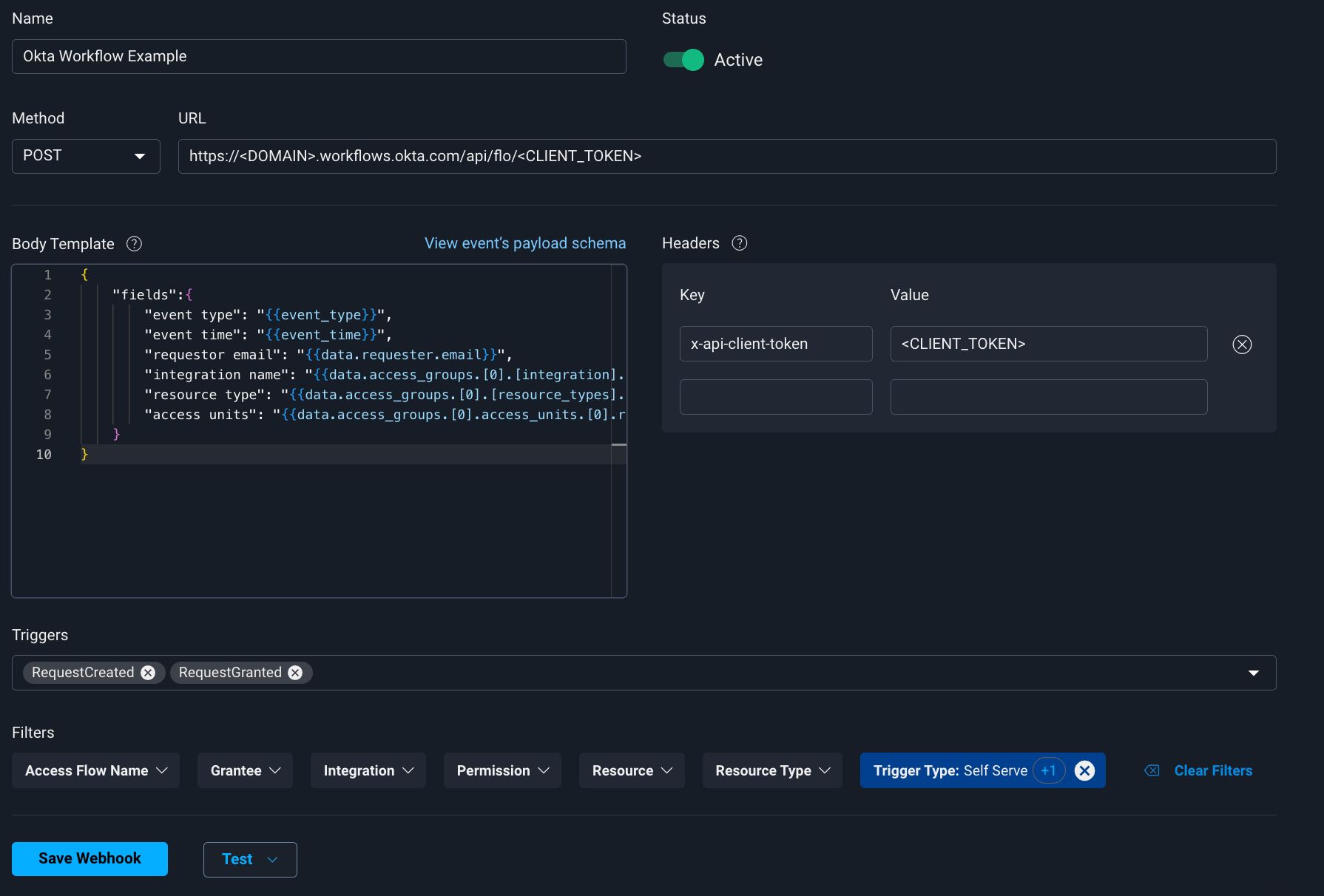
Webhooks are automated messages sent from Apono to other systems when specific events occur. They enable real-time integration between Apono and your internal tools.

<figure><img src="https://1094436629-files.gitbook.io/~/files/v0/b/gitbook-x-prod.appspot.com/o/spaces%2Fv6MBfUGvblSdAz31yJXm%2Fuploads%2Fgit-blob-508d55a0a35aa81992743283c91e81b58b283eb6%2Fwebhooks-overview.png?alt=media" alt="Edit Webhook tab" width="563"><figcaption><p>Edit Webhook tab</p></figcaption></figure>

Webhooks offer several key benefits for security and operations:

* Real-time security event detection and response
* Automated cross-system workflows
* Reduced manual oversight
* Seamless tool integration
* Comprehensive audit trails

***

### Features

All webhooks have the following core features.

<table><thead><tr><th width="216">Feature</th><th>Notes</th></tr></thead><tbody><tr><td><strong>Security</strong></td><td><p>Maintains information security:</p><ul><li><strong>HTTPS Protocol</strong>: Mandatory secure communications</li><li><strong>Port Restrictions</strong>: No custom ports allowed</li></ul></td></tr><tr><td><strong>Authentication</strong></td><td><p>Supports the following authentication:</p><ul><li>Bearer Token</li><li>OAuth</li><li>Custom header-based</li></ul></td></tr><tr><td><strong>Payload Structure</strong></td><td>Customizable JSON format</td></tr><tr><td><strong>Webhook Verification</strong></td><td>Built-in testing capabilities</td></tr></tbody></table>

***

### Type of Webhooks

Apono offers three specialized types of webhooks, each designed for specific use cases.

<table><thead><tr><th width="218">Webhook Type</th><th>Description</th></tr></thead><tbody><tr><td><a href="anomalies"><strong>Anomaly</strong></a></td><td><p>Focuses on security and unusual behavior detection</p><p>These notifications provide the following insights:</p><ul><li>Alerts about high-risk and previously rejected access requests</li><li>Sudden activities from inactive users</li><li>Suspicious automated actions</li></ul></td></tr><tr><td><a href="audit-log-webhook"><strong>Audit Log (Syslog)</strong></a></td><td><p>Tracks system changes and administrative actions</p><p>These notifications provide the following insights:</p><ul><li>Chronological record of who did what, when, and where</li><li>Transparent audit trails for compliance and accountability</li></ul></td></tr><tr><td><strong>Request</strong></td><td><p>Enables creating flexible webhooks for custom integrations</p><p><strong>Categories</strong>:</p><ul><li><a href="request-webhook/custom-webhooks">Custom Webhooks</a></li><li><a href="request-webhook/communications-and-notifications">Communications and Notifications</a></li><li><a href="request-webhook/itsm">ITSM</a></li><li><a href="request-webhook/logs-and-siems">Logs and SIEMs</a></li><li><a href="request-webhook/orchestration-and-workflow-builders">Orchestrations and Workflow Builders</a></li></ul></td></tr><tr><td><a href="integration-webhook"><strong>Integration</strong></a></td><td><p>Monitors integration health and connection issues</p><p>These notifications provide the following insights:</p><ul><li>Warnings and errors from connected integrations</li><li>Early signs of degraded service or failures</li><li>Specific issue details to speed troubleshooting</li></ul></td></tr></tbody></table>

#### IP addresses

Apono's webhooks send requests from the following IPs:

* 44.219.84.65
* 52.0.80.43
* 3 .95.51.126
* 3.219.111.107


---

# Agent Instructions: Querying This Documentation

If you need additional information that is not directly available in this page, you can query the documentation dynamically by asking a question.

Perform an HTTP GET request on the current page URL with the `ask` query parameter:

```
GET https://docs.apono.io/docs/webhook-integrations/intro-to-apono-outbound-webhooks.md?ask=<question>
```

The question should be specific, self-contained, and written in natural language.
The response will contain a direct answer to the question and relevant excerpts and sources from the documentation.

Use this mechanism when the answer is not explicitly present in the current page, you need clarification or additional context, or you want to retrieve related documentation sections.
