Integrate an AWS account or organization
Learn how to complete an AWS integration in the Apono UI
Apono offers AWS users a simple way to centralize cloud management through our platform. Through a single integration, you can manage multiple AWS services across various accounts and organizations.
Integrate an AWS account
Prerequisites
Apono connector installed in your AWS account
To sync and manage access to EC2 servers, make sure you add the
AmazonSSMManagedInstanceCorepolicy to the connector's IAM role
Integration

You can also use the steps below to integrate with Apono using Terraform.
In step 10, instead of clicking Confirm, follow the Are you integrating with Apono using Terraform? guidance.
Follow these steps to integrate Apono with your AWS account:
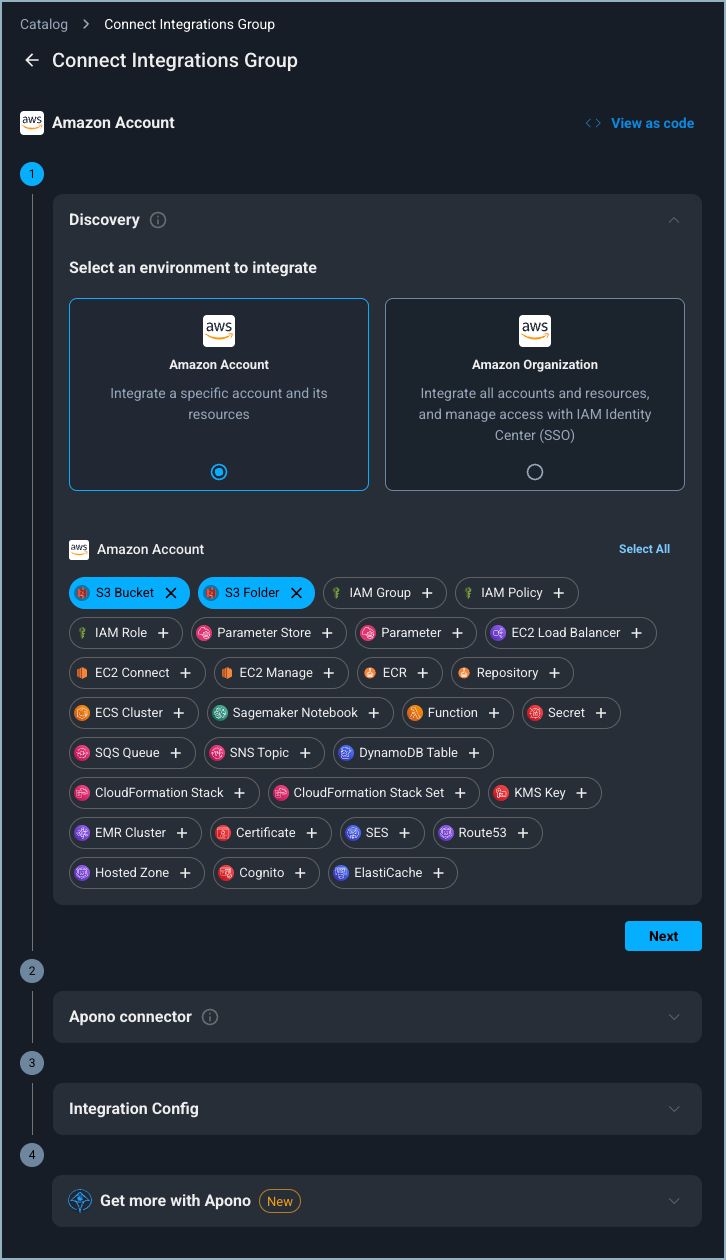
On the Catalog tab, click AWS. The Connect Integrations Group page appears.
Under Discovery, click Amazon Account.
Click one or more resource types to sync with Apono.
Click Next. The Apono connector section expands.
From the dropdown menu, select a connector. Choosing a connector links Apono to all the services available on the account where the connector is located.
Click Next. The Integration Config section expands.
Define the Integration Config settings.
SettingDescriptionIntegration Name
Unique, alphanumeric, user-friendly name used to identify this integration when constructing an access flow
Region
Region in which the organization runs
AWS Profile Name
(Optional) Name of the AWS profile By default, Apono sets this value to apono.
Click Next. The Get more with Apono section expands.
Define the Get more with Apono settings.
SettingDescriptionCredential Rotation
(Optional) Number of days after which the database credentials must be rotated Learn more about the Credentials Rotation Policy.
User cleanup after access is revoked (in days)
(Optional) Defines the number of days after access has been revoked that the user should be deleted
Learn more about Periodic User Cleanup & Deletion.
Custom Access Details
(Optional) Instructions explaining how to access this integration's resources Upon accessing an integration, a message with these instructions will be displayed to end users in the User Portal. The message may include up to 400 characters. To view the message as it appears to end users, click Preview.
Integration Owner
(Optional) Fallback approver if no resource owner is found Follow these steps to define one or several integration owners:
From the Attribute dropdown menu, select User or Group under the relevant identity provider (IdP) platform.
From the Value dropdown menu, select one or multiple users or groups.
NOTE: When Resource Owner is defined, an Integration Owner must be defined.
Resource Owner
(Optional) Group or role responsible for managing access approvals or rejections for the resource Follow these steps to define one or several resource owners:
Enter a Key name. This value is the name of the tag created in your cloud environment.
From the Attribute dropdown menu, select an attribute under the IdP platform to which the key name is associated. Apono will use the value associated with the key (tag) to identify the resource owner. When you update the membership of the group or role in your IdP platform, this change is also reflected in Apono.
NOTE: When this setting is defined, an Integration Owner must also be defined.
Click Confirm.
After connecting your AWS account to Apono, you will be redirected to the Connected tab to view your integrations. The new AWS integration will initialize once it completes its first data fetch. Upon completion, the integration will be marked Active.
Now that you have completed this integration, you can create access flows that grant permission to AWS IAM resources, such as AWS Roles.
Integrate an AWS organization
Prerequisites
Apono connector installed in your AWS management account OR a connector with delegate permissions
To sync and manage access to EC2 servers, make sure you add the
AmazonSSMManagedInstanceCorepolicy to the connector's IAM role
Integration

Follow these steps to integrate Apono with your AWS organization:
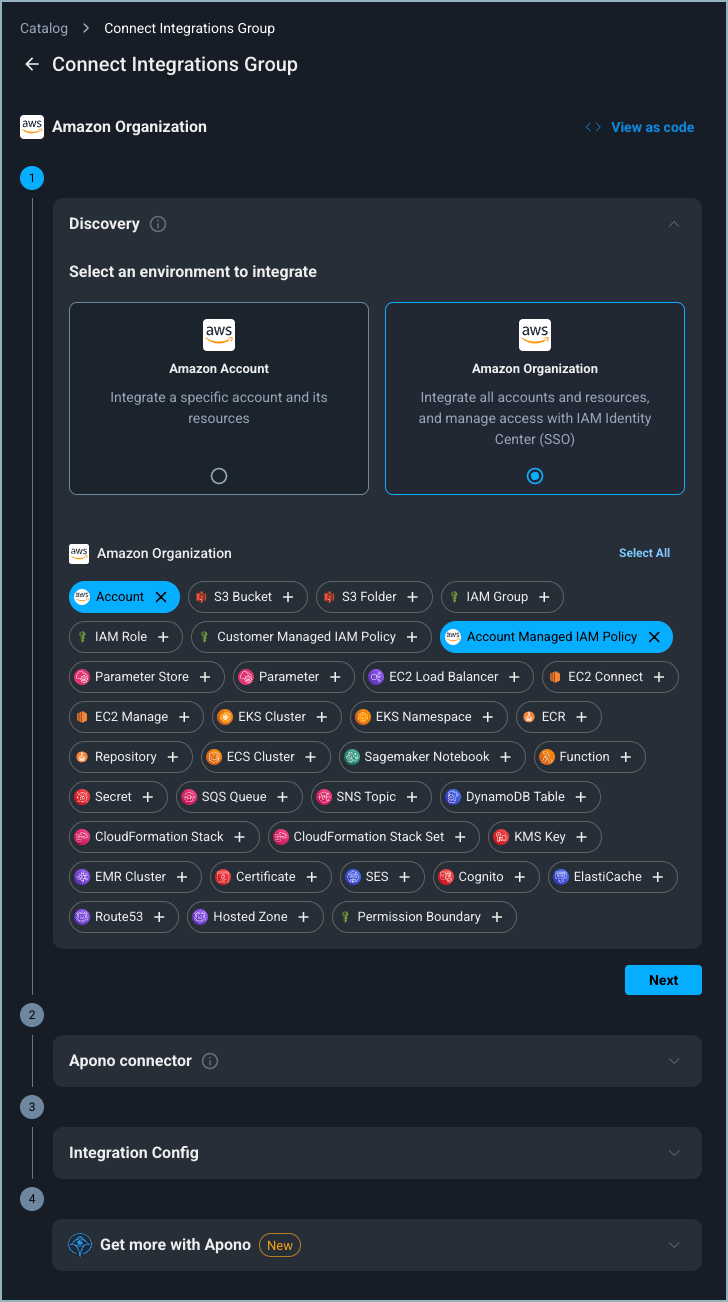
On the Catalog tab, click AWS. The Connect Integrations Group page appears.
Under Discovery, click Amazon Organization.
Click one or more resource types to sync with Apono.
Select the Permission Boundary resource to allow Apono to temporarily restrict overprivileged access.
To learn more about how to manage overprivileged access, read about Access Discovery.
Click Next. The Apono connector section expands.
From the dropdown menu, select a connector. Choosing a connector links Apono to all the services available on the account where the connector is located.
Click Next. The Integration Config section expands.
Define the Integration Config settings.
SettingDescriptionIntegration Name
Unique, alphanumeric, user-friendly name used to identify this integration when constructing an access flow
Region
Region in which the organization runs
AWS SSO Region
Region for which your single sign-on is configured
SSO Portal
Single sign-on URL This is required for Apono to generate a sign-in link for end users to use their granted access.
Management Account Role ARN
(Optional) ARN (step 5) of the role to assume in the management account
Exclude Organization Unit IDs
(Optional) Comma-separated list of organizational unit IDs to exclude Example: ou-aaa1-1111,ou-bbb2-2222
Exclude Account IDs
(Optional) Comma-separated list of account IDs to exclude Example: 7665544332211,7665544332222,766554433333333
Click Next. The Get more with Apono section expands.
Define the Get more with Apono settings.
SettingDescriptionCustom Access Details
(Optional) Instructions explaining how to access this integration's resources Upon accessing an integration, a message with these instructions will be displayed to end users in the User Portal. The message may include up to 400 characters. To view the message as it appears to end users, click Preview.
Integration Owner
(Optional) Fallback approver if no resource owner is found Follow these steps to define one or several integration owners:
From the Attribute dropdown menu, select User or Group under the relevant identity provider (IdP) platform.
From the Value dropdown menu, select one or multiple users or groups.
NOTE: When Resource Owner is defined, an Integration Owner must be defined.
Resource Owner
(Optional) Group or role responsible for managing access approvals or rejections for the resource Follow these steps to define one or several resource owners:
Enter a Key name. This value is the name of the tag created in your cloud environment.
From the Attribute dropdown menu, select an attribute under the IdP platform to which the key name is associated. Apono will use the value associated with the key (tag) to identify the resource owner. When you update the membership of the group or role in your IdP platform, this change is also reflected in Apono.
NOTE: When this setting is defined, an Integration Owner must also be defined.
Click Confirm.
After connecting your AWS account to Apono, you will be redirected to the Connected tab to view your integrations. The new AWS integration will initialize once it completes its first data fetch. Upon completion, the integration will be marked Active.
Enable multi-region resource discovery in Apono
Apono leverages AWS Resource Explorer for multi-region scans for your AWS Organization integration. Apono uses this organization-level configuration to automatically deploy local indexes and aggregate them into a single searchable view.
This configuration provides:
A centralized aggregator index for organization-wide search
Automated creation and maintenance of local indexes
Consistent visibility across teams, regions, and environments
Less manual setup and fewer cross-account visibility gaps
Prerequisites
AWS Organization
An AWS organization must be integrated with Apono.
All organizational units (OUs) or accounts you plan to include as part of the target must be structured within the AWS organization.
Admin account user or role
A user or role used to run Quick Setup in the management (Admin) account.
This user or role must be able to complete these tasks:
Enable trusted access in AWS Organizations
Configure Resource Explorer
Use Systems Manager Quick Setup
Use AWS Resource Access Manager (RAM)
View CloudFormation, SSM, and Resource Explorer status
Option A
Use a role or user with the AWS-managed AdministratorAccess policy in the Admin account to prevent hidden blocking conditions.
Option B
Create a role in the Admin account (such as ResourceExplorerAdmin) with a custom managed policy similar to the following example.
Service Control Policy (SCP)
SCPs must not deny CloudFormation in any target account or region:
SCPs must not explicitly deny:
cloudformation:CreateStackcloudformation:UpdateStackcloudformation:*
Region-restriction SCPs (
aws:RequestedRegion) must adhere to one of the following:Include all required regions in the allowlist.
Explicitly exempt CloudFormation from an explicit denial by adding
cloudformation:*toNotAction.
IMPORTANT: Failure to adhere to these SCP requirements will prevent Quick Setup from successfully deploying in regions where the SCP has denied CloudFormation.
Enable trusted access for Resource Explorer
Follow these steps to enable trusted access:
From your Admin account, open AWS Resource Explorer.
From the navigation, click Settings. The Settings page appears.
In the multi-account/organization section, follow the prompt to Enable trusted access.
You can also enable trusted access from AWS Organizations.
Follow these steps:
From your Admin account, open AWS Organizations.
From the navigation, click Services. The Services page appears.
Click AWS Resource Explorer. The AWS Resource Explorer page opens.
If Trusted access is disabled, click Enable trusted access. The Enable trusted access for AWS Resource Explorer pop-up window appears.
Click Show the option to enable trusted access for AWS Resource Explorer without performing additional setup tasks.
Type enable in the text field.
Click Enable trusted access.
Configure the organization deployment
Follow these steps to configure the organization deployment:
Open the Quick Setup from the Systems manager or Resource Explorer.
Select the Aggregator Index Region. This region becomes the central location for organization-wide search.
Under Targets, select the accounts that include the resources you want discovered:
Entire Organization: (Recommended) Enables complete visibility
Specific OUs: Enables scoping deployment
From the regions selector, choose all regions where Resource Explorer should create indexes.
Under Summary, review the aggregator region, targets, and regions.
Select Create. The Quick Setup will deploy the following:
Local indexes in each selected region or account
An aggregator index in the Aggregator Region
Default views for centralized search
Verify the deployment
After the deployment has completed, follow these steps to verify the deployment:
From the Admin account, open AWS Resource Explorer.
From the navigation, click Settings. The Settings page opens.
Under Indexes, locate the region set as the aggregator index during the Quick Setup. The region should be denoted as Aggregator.
Spot check a member account:
Log in as or assume the role of a sample member account.
Open AWS Resource Explorer in one region that should have an index to ensure an index exists and is Active.
Open AWS Resource Explorer in one region that should not have an index to confirm an index does not exist.
Troubleshoot Quick Setup
Now that you have completed this integration, you can create access flows that grant permission to AWS IAM resources, such as AWS Roles.
Troubleshooting
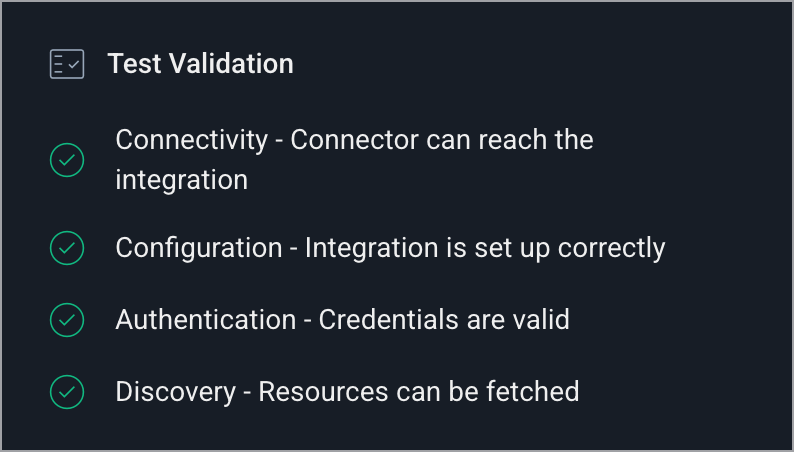
Please refer to our troubleshooting guide if you encounter errors while integrating.
Last updated
Was this helpful?